Hell a
Does Islam tell Muslims to love or hate those outside the faith? |
QuranAs mentioned, there are nearly 500 verses from 87 Suras that speak of Hell. This is just a sample:
Quran (40:71-72) - When the fetters and the chains shall be on their necks; they shall be dragged Into boiling water, then in the fire shall they be burned
Quran (22:19-21) - But as for those who disbelieve, garments of fire will be cut out for them; boiling fluid will be poured down on their heads; Whereby that which is in their bellies, and their skins too, will be melted; And for them are hooked rods of iron
Quran (4:56) - Those who disbelieve Our revelations, We shall expose them to the Fire. As often as their skins are consumed We shall exchange them for fresh skins that they may taste the torment Lo! Allah is ever Mighty, Wise
Quran (56:92-94) - But if he is of the rejecters, the erring, then the welcome will be boiling water and roasting at hell-fire
As to what regard Muslims are to show for those who don't believe, the Quran says to be ruthless toward them, since they are going to Hell anyway:
Quran (9:73) - O Prophet! strive hard against the unbelievers and the hypocrites and be unyielding to them; and their abode is hell, and evil is the destination
Quran (66:9) - O Prophet! Strive against the disbelievers and the hypocrites, and be stern with them. Hell will be their home, a hapless journey's end.
Quran (8:55) - Surely the vilest of animals in Allah's sight are those who disbelieve
Quran (9:30) - And the Jews say: Ezra is the son of Allah, and the Christians say: The Messiah is the son of Allah... Allah (Himself) fighteth against them. How perverse are they!
Quran (4:52) - Those (Christians) are they whom Allah hath cursed...
Quran (4:47) - O you (Jews) who have been given the Book! believe that which We have revealed, verifying what you have, before We alter faces then turn them on their backs, or curse them as We cursed the violaters of the Sabbath, and the command of Allah shall be executed. Quran (5:59-60) - This verse begets the infamous belief on the part of some Muslims that Jews are descended from swine and apes, since it says that wicked Jews (at least) were transformed by Allah in the past. (See also 2:64)
The Quran also contains dozens of verses that specifically describe Jews in the ugliest, most hateful terms. These parts of the Quran are indistinguishable from hate literature.
|
Hadith and SiraThere are hundreds of verses from the traditions that speak of violence and hatred against non-Muslims, particularly Allah's intense dislike, manifested by his plans to physically torture them for eternity.Sahih Bukhari (54:487) - Someone asked, "O Allah's Apostle This (ordinary) fire would have been sufficient (to torture the unbelievers)," Allah's Apostle said, "The (Hell) Fire has 69 parts more than the ordinary (worldly) fire, each part is as hot as this (worldly) fire." In other words, ordinary fire isn't hot enough to torture non-Muslims. Therefore the fire in Hell is 69 times hotter. Sahih Bukhari (2:28) - Women comprise the majority of Hell's occupants. (A weak Hadith, Kanz al-`ummal, 22:10, even suggests that 99% of women go to Hell). Sahih Muslim (40:6831) - Non-Muslims in Hell will be given thick skin so as to prolong their agony (before they are given fresh skin for a new round of torture - Quran verse 4:56). Sahih Bukhari (59:727) - Allah's Apostle [said]... "Allah's curse be on the Jews and the Christians" This was spoken on Muhammad's death bed, and was one of the last things that he ever said. Ishaq 240 - "The Jews are a nation of liars.... The Jews are a treacherous, lying, and evil people" |
NotesJustice is difficult to find in the character of Allah. Not only does the god of Islam appear to punish people disproportionately for mere unbelief, but he explicitly creates them to be nothing more than "fuel for the fire" of hell (Quran 72:15) and he actually "causes the unjust to go astray" (Quran 14:27) (see also verses 74:31 and18:17) even though he has the ability to lead everyone down the right path (Quran 16:9). A person's good deeds are for naught (Quran 18:104-106). Allah even sends the wives of "evil-doers" to Hell without apparent regard for their own guilt (Quran 37:22).The actions of Muslims often reflect this hatred for non-believers. Those who kill do so because they believe they have a religious mandate. Others celebrate or tacitly support terror attacks. The Muslim mainstream never gets all that upset about terror (usually turning each event into a pity party for themselves). Even the mass murder of 9/11 was cheered by some (though condemned by many others). With hatred confirmed by close to 500 verses that speak of Allah's wrath against unbelievers, the effort to mine those rare diamonds that do speak of love and tolerance must be a true study in cherry picking. Such presentations usually begin with wild rhapsody that rarely delivers (ie. "the following verses will shatter completely all the lies about Islam advocating or promoting hate. It shows total respect to people from different religions and backgrounds..."). These apologists commonly ignore other, far more prevalent verses that preach hatred, death, and doom. They also ignore the history of Islam and its relegation of nonbelievers to third-class status, with taxes and discrimination rooted in the Quran and traditions of Muhammad. More importantly, they neglect to mention that these verses come from an earlier time period and are abrogated by later ones. Take the most popular example, Quran (2:62) - "Those who believe (in the Quran), and those who follow the Jewish (scriptures), and the Christians and the Sabians,- any who believe in Allah and the Last Day, and work righteousness, shall have their reward with their Lord; on them shall be no fear, nor shall they grieve." This sounds like tolerance for other faiths. But this is also from the earliest Medinan Sura (the same one that famously speaks of "no compulsion in religion"). The verse was "revealed" just after Muhammad and his 100 followers were expelled from Mecca and desperately needed to make alliances with the people around them in their new home town of Medina. Most of their neighbors were not Muslims, and if Muhammad and his tiny group were to have informed the people around them of their religious inferiority and ultimate doom, they would not have had the opportunity to gain power. By contrast, the 9th and 5th Suras are among the most intolerant of the Quran, and they are also considered the final narrations. The same seems to hold true for Sura 3, which is an exercise in contradiction. Verse 151 condemns Christians to Hell for believing in the Trinity, while verses 113-116 say that there are among the People of the Book who believe in Allah and the Last Day and are in "the ranks of the righteous." In order to stay on the safe side, however, Muhammad warns in verse 118 against taking "for intimate friends from among others than your own people." It also helps to remember that this Sura was an early Median verse, like Sura 2, but it follows the Battle of Badr, and occurs at a time when Muslims were gaining strength in the community and could afford to be more arrogant. Taken as a whole, no other religion on earth has the mandate that Islam does to dominate those outside the faith politically and culturally. Non-Muslims are to be subjugated and forced to pay money to Muslims, according to the Quran's 9th sura and various Hadith. Islamic law (Sharia) not only governs the affairs of Muslims, but non-Muslims as well. It proscribes a body of rules that systematically discriminates against those of other faiths, denying them legal rights, restricting their religious practices, and even determining where they are allowed to build houses. One of the more common tricks that today's Muslims play on the truly naive is to say that Muhammad instructed his followers to love and not to hate. This is a partial truth. There are hadith that tell Muslims not to hate and not to do harm in word or deed (Muslim (1:65)) but the context and exact wording makes it very clear that this applies within the Muslim community to a believer's relations with fellow Muslims. These are not commands that govern a Muslim's obligation to the general community. Another game that Muslim scholars play to compensate for the absence of verses concerning universal love is to appeal to verses of the Bible. Such scholars assert that since Islam is based on the two earlier religions of Judaism and Christianity, it therefore inherits the concepts of peace, love and tolerance in the New Testament that are missing from the Quran. But, of course, Muslims are not taught to believe the Old and New Testaments outright. There is no rote memorization of such scripture as there is for the Quran. There are also abundant historical and theological contradictions between the Quran and the Bible, from the Trinity to Redemption. For example, the Quran says that the crucifixion never happened - something that hardly anyone else denies. Of course, it also claims that the mother of Jesus was the sister of Moses, since the characters share the same name, even though they are separated by at least 13 centuries. (Needless to say, the Quran really isn't the best source for Judeo-Christian theology). In short, it is highly disingenuous for Muslims to fill in the missing pieces of their faith by picking and choosing what they will from other religions to conveniently fit the fashion of the times. (This is particularly tasteless given the persecution that Muslim rulers have meted out historically on non-Muslim populations). Muhammad chose to say little about universal love and brotherhood, yet so much about killing and eternal doom. no place in the Quran where Muhammad tells Muslims to love people of other religions |
Tuesday, April 11, 2017
Does Islam tell Muslims to love or hate those outside the faith?

Monday, April 10, 2017
It’s not the religion that creates terrorists, it’s the politics
 |
| Abrahams PIc |
The radicalisation hypothesis steers us away from the real causes of terrorism – and enables the west to maintain its denial about a role in helping create it
“How do we stop young Muslims becoming radicalised?” is the question we now continually ask. But it’s a deeply misleading question because it points us in the wrong direction. Why? Because it contains a hidden assumption that it is radical ideas, specifically Islamic theological ideas, that are the root cause of turning a young lad from West Yorkshire into an Isis suicide bomber in Iraq. According to the radicalisation hypothesis, it’s conservative Islam and the dangerous ideas contained in the Qur’an that motivate murderous behaviour.
We want to tell ourselves that we are secular and enlightened and so have no part in all of this bloodshed
To me this is about as convincing as arguing that the murderous bits of the Bible were responsible for the brutality of the IRA. For many of the young people who have been persuaded to go off and fight in Syria and Iraq have hardly got past the first chapter of Islam for Dummies. They often know next to nothing about the Qur’an and are about as motivated by reading the few passages they have as the average republican terrorist was motivated by Saul’s genocidal destruction of the Amalekites in the first book of Samuel. Yes, the language of violent jihad may borrow its vocabulary from Islamic theology – it’s a useful marker of shared identity – but root motivation is as it always is: politics. The IRA weren’t Bible-believing Catholics, they were mostly staunch atheists. Catholicism was simply a marker of who counted as “one of us”. And the same is true of Islamic terrorism.
Earlier this year, Professor Arun Kundnani published a fascinating account of how the rhetoric of radicalisation has created “a decade lost”. In it, he summarises the flimsy empirical basis on which the connection between radical theology and terrorism has been built and the extent to which the burgeoning radicalisation industry, especially in academia, is linked by a revolving door to conservative political lobbyists keen to blame conservative Islam for terrorism.
FacebookTwitterPinterest
The reason this is important has nothing to do with exonerating religion. I don’t care about apologetics here. So let me acknowledge that both the Qur’an and the Bible have passages that are deeply immoral. But don’t get distracted by this. For this is not how or why people go to Iraq to become murderous criminals. They go – largely – because they believe their tribe is under attack, that Bashar al-Assad is dropping chlorine gas, that the west invaded Iraq, because of torture and Guantánamo Bay, and because they have a warped and misguided sense of adventure in responding to all this.

The stories you need to read, in one handy email
Read more
We buy into the radicalisation hypothesis because we want evil to be mysterious and other; something that has nothing to do with us. We want to tell ourselves that we are secular and enlightened and so have no part in all of this bloodshed. It’s what people commonly do with evil – we conceptualise it as being as far away from us as possible. But if Islamic terrorism is really all about politics, then we have to admit that the long history of disastrous western interventions in the Middle East is a part of the cause of the horror that continues to unfold. In other words, we have to face our responsibility.
But even more troubling than the evasion of responsibility that is built into the radicalisation hypothesis is the fact that it points us in the wrong direction when looking for how to prevent it. If you want to find a terrorist, look for people buying dodgy chemicals, not people saying their prayers.
@giles_fraser
https://www.theguardian.com/
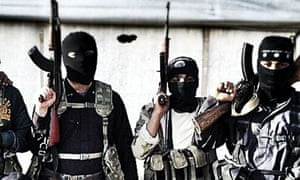 |
| British Islamic State fighters in Syria, August 2014. ‘We buy into the radicalisation hypothesis because we want evil to be mysterious and other; something that has nothing to do with us.’ Photograph: Tim Stewart News/Rex |
The word “radical” has always been an overly capacious term, easily filled with whatever meaning the speaker wants to pour into it. There is the radical right, the radical left, even the radical centre, whatever that means. Traditionally associated with the 18th-century English struggle to extend the franchise and with the cause of freedom, it has been one of those words no modern politician can do without. Google any of the current crop of parliamentarians adding the words “radical vision” and see what I mean. They’re all at it, all claiming it. Unless, of course, you put the word Islamic first. And then it immediately becomes a bogey word.
“How do we stop young Muslims becoming radicalised?” is the question we now continually ask. But it’s a deeply misleading question because it points us in the wrong direction. Why? Because it contains a hidden assumption that it is radical ideas, specifically Islamic theological ideas, that are the root cause of turning a young lad from West Yorkshire into an Isis suicide bomber in Iraq. According to the radicalisation hypothesis, it’s conservative Islam and the dangerous ideas contained in the Qur’an that motivate murderous behaviour.
We want to tell ourselves that we are secular and enlightened and so have no part in all of this bloodshed
To me this is about as convincing as arguing that the murderous bits of the Bible were responsible for the brutality of the IRA. For many of the young people who have been persuaded to go off and fight in Syria and Iraq have hardly got past the first chapter of Islam for Dummies. They often know next to nothing about the Qur’an and are about as motivated by reading the few passages they have as the average republican terrorist was motivated by Saul’s genocidal destruction of the Amalekites in the first book of Samuel. Yes, the language of violent jihad may borrow its vocabulary from Islamic theology – it’s a useful marker of shared identity – but root motivation is as it always is: politics. The IRA weren’t Bible-believing Catholics, they were mostly staunch atheists. Catholicism was simply a marker of who counted as “one of us”. And the same is true of Islamic terrorism.
Earlier this year, Professor Arun Kundnani published a fascinating account of how the rhetoric of radicalisation has created “a decade lost”. In it, he summarises the flimsy empirical basis on which the connection between radical theology and terrorism has been built and the extent to which the burgeoning radicalisation industry, especially in academia, is linked by a revolving door to conservative political lobbyists keen to blame conservative Islam for terrorism.
FacebookTwitterPinterest
The reason this is important has nothing to do with exonerating religion. I don’t care about apologetics here. So let me acknowledge that both the Qur’an and the Bible have passages that are deeply immoral. But don’t get distracted by this. For this is not how or why people go to Iraq to become murderous criminals. They go – largely – because they believe their tribe is under attack, that Bashar al-Assad is dropping chlorine gas, that the west invaded Iraq, because of torture and Guantánamo Bay, and because they have a warped and misguided sense of adventure in responding to all this.
The stories you need to read, in one handy email
Read more
We buy into the radicalisation hypothesis because we want evil to be mysterious and other; something that has nothing to do with us. We want to tell ourselves that we are secular and enlightened and so have no part in all of this bloodshed. It’s what people commonly do with evil – we conceptualise it as being as far away from us as possible. But if Islamic terrorism is really all about politics, then we have to admit that the long history of disastrous western interventions in the Middle East is a part of the cause of the horror that continues to unfold. In other words, we have to face our responsibility.
But even more troubling than the evasion of responsibility that is built into the radicalisation hypothesis is the fact that it points us in the wrong direction when looking for how to prevent it. If you want to find a terrorist, look for people buying dodgy chemicals, not people saying their prayers.
@giles_fraser
https://www.theguardian.com/
Ten Obvious Reasons Why Islam is Not a Religion of Peace
Ten Obvious Reasons Why
| ||||||||||||||||||||
|

Police defuse explosive device outside Oslo tube station

Police have made safe an explosive device found outside a busy underground station in central Oslo.
Officers evacuated late-night bars and restaurants in the Norwegian capital as bomb disposal experts rushed to the scene.
Authorities later said the device was neutralised and a suspect arrested.
Police chief Vidar Pedersen said the device, initially described as "bomb-like", was an explosive.
No injuries were reported.
Police would not give any details about the suspect or further information about the device.
Mr Pedersen said the device was found on the street just outside the Groenland underground station and police ordered people to leave bars and restaurants.
"Every restaurant was being closed," said Malin Myrvold, 23, who witnessed the scene from a fourth-storey window.
"You could see cops in heavy armour going in every store and restaurant.
"We were trying to see what was going on. The police were screaming at us to get back inside and stay where we were."
Norway was put on high alert after neighbouring Sweden suffered a truck attack in the capital Stockholm that killed four people and injured 15. The suspect in Friday's attack, a 39-year-old native of Uzbekistan, has been arrested.
It was unclear whether he was also a Swedish citizen or resident or even how long he had been in the country.
The Norwegian incident happened less than a mile from the government buildings that were damaged in a deadly bomb attack carried out by right wing extremist Anders Breivik in 2011.
That bomb and a subsequent gun massacre killed a total of 77 people.
Egypt Coptic church attack: video shows lead-up to suicide bombing
CCTV footage has emerged showing the moments leading up to the bombing of St Mark’s Cathedral in Alexandria, Egypt. The attack at the Coptic church killed at least 16 people and wounded 41. In the footage, the suicide bomber can be seen approaching the gates to the church and being turned away, before he walks over to a security screening gate and detonates his explosives.
 |
Egyptian Christians bury bomb attack victims as state of emergency takes effect |
Subscribe to:
Posts (Atom)
wanted officials
